

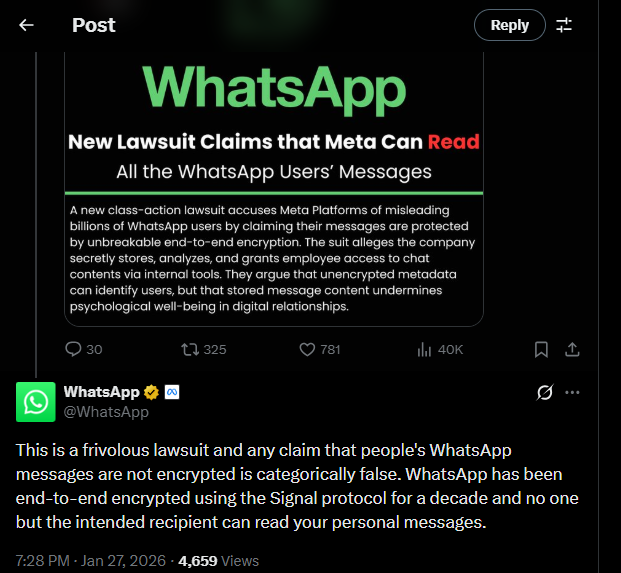
WhatsApp has dismissed a class-action lawsuit accusing its parent company, Meta Platforms, of misleading users about the privacy of their messages, insisting that personal chats remain protected by end-to-end encryption.
In a statement shared via its X account on Tuesday, January 27, 2026, WhatsApp described the lawsuit as frivolous and rejected claims that it can read users’ private messages.
The company reiterated that WhatsApp has been end-to-end encrypted using the Signal protocol for more than a decade, maintaining that only the sender and the intended recipient can access message content.
“This is a frivolous lawsuit, and any claim that people’s WhatsApp messages are not encrypted is categorically false. WhatsApp has been end-to-end encrypted using the Signal protocol for a decade, and no one but the intended recipient can read your personal messages,” WhatsApp stated.
Lawsuit
The lawsuit, filed in the United States, says that Meta misled billions of WhatsApp users worldwide by promoting the platform as offering unbreakable end-to-end encryption.
According to the plaintiffs, Meta secretly stores and analyses WhatsApp message content and allows employees to access chats through internal tools, despite public assurances that such access is technically impossible.
Court filings further argue that while WhatsApp acknowledges collecting unencrypted metadata such as phone numbers, contact lists and usage patterns, the reported storage of message content goes beyond metadata collection.
The plaintiffs claim this practice undermines users’ trust and negatively affects psychological well-being in digital relationships, particularly where users rely on WhatsApp for intimate, confidential or sensitive communication.
The lawsuit seeks class-action status and accuses Meta of violating consumer protection and data-privacy laws by misrepresenting the true level of privacy offered on the platform. If certified, the case could potentially involve millions of WhatsApp users across multiple countries.
End-to-end encryption
WhatsApp have rejected these claims, saying they are based on a fundamental misunderstanding of how end-to-end encryption works. The company insists it does not store encryption keys, does not retain message content and does not provide employees with access to private chats.
According to WhatsApp, end-to-end encryption ensures messages are encrypted on a user’s device and can only be decrypted on the recipient’s device. While messages pass through WhatsApp’s servers, the company says they remain unreadable at all times. WhatsApp uses the Signal protocol, a widely trusted open-source encryption standard also used by other secure messaging platforms.


No comments yet. Be the first to share your thoughts!